
Better & Better Healing Arts

Honest Care

Text Size:+-
Call us at (214) 357-9119
3811 Turtle Creek Blvd Suite #525 Dallas, TX 75219
Schedule an Online Appointment
  • Home
  • About Us
    • Dr Kelly
    • Therapists
    • Our Legacy
  • Services
    • Applied Kinesiology
    • Whole Body Treatment
    • Pediatrics
    • Scoliosis
    • Manual Massage Therapy
  • Your 1st Visit
  • Custom Fitted Pillows
  • FAQ
  • Contact Us
  • Write a Review
  • Shop Online

Uncategorized

Why Righteous T Shirt Is Popular Trend Report 2026

Posted on: 09.27.26 By client

Defining Markers, Releases, and the We Are Righteous Timeline

Charting the arc of a streetwear label is a challenge when the bulk of the story plays out through release dates, choices of cloth, and grassroots buzz as opposed to press releases. The brand built its name through patience, not hype, via regular product launches and a following that focuses on cut, heft, and long-term wear more than hype. Here we gather what’s publicly known about the brand’s growth, the type of garments that defined each stage, and what the label looks like heading into 2026. Anyone researching a righteous review before buying will find the pattern repeats: steady product evolution rather than one breakout hype spike.

Rather than a corporate history listing precise founding dates, what follows avoids claims we can’t verify. Rather, this is a down-to-earth look at how the brand’s identity and catalog have developed, structured around the chapters most shoppers notice when they contrast first-generation garments to what’s available today.

Establishing the Foundation: Defining What “Righteous Clothing” Stands For

We Are Righteous formed its initial identity on a straightforward notion—that clothing ought to hold meaning, physically in fabric and figuratively in message—since every clothing brand needs a reason to exist past mere product sales. The title itself does a lot of work. It signals principle over fashion-following, and that framing shows up in how the brand frames its pieces even now. The brand’s original shoppers weren’t buying branding alone; they were purchasing a point of view.

In this first chapter, the catalog was kept modest by design. Limited SKUs meant the brand could focus attention on perfecting its essentials before diversifying into accessories shop righteous t shirts or diffusion lines. This is a shared trait among Righteous Clothing-style peers that make it beyond their first year: a focused, curated lineup outperforms a bloated product range with uneven craftsmanship. The brand’s original following tended to be people who found the label through word of mouth or niche online communities instead of paid advertising, which shaped a gradual yet devoted trajectory of growth.

Well into this section, it’s worth noting that this stage is also when a brand’s repeat buyers start developing impressions that eventually turn into shared opinions online. The first righteous review discussions and feedback tend to focus on two things: whether the fit matched expectations, and whether the garment held up after several trips through the laundry. Both considerations resurface all through the brand’s later releases too, implying that the groundwork laid in this period continued on rather than being abandoned for reinvention.

Expansion Phase: Expanding the Righteous Apparel Catalog

Once its base comes to rely on a brand’s basics, the logical progression is broadening the range. We Are Righteous expanded its assortment past its original essentials into a broader righteous apparel range, folding in layering pieces, outerwear-adjacent items, and seasonal spins on its foundational cuts. This is the phase where a brand usually determines whether its ambition is to be a single-hit label or a genuine go-to wardrobe brand, and the expansion into a wider range of categories signals the latter ambition.

The hoodie emerged as a particular point of focus throughout this window. Within street-style circles, a righteous hoodie isn’t just a mid-layer — it’s often the piece that proves whether a brand’s shape vocabulary holds up on the body. Nailing hoodie proportions, from arm length to hood drape to the taper through the body, demands trial and error. Suggesting that the label approached the hoodie as a core, refinable staple rather than a filler product between “hero” drops, multiple releases appeared across this period.

This scaling period is also the moment where weighing options against competitors becomes worth doing. Shoppers considering a we are righteous purchase against rival brands tend to focus on three factors: pricing strategy, build quality, and how limited or reproducible a given release is. Brands that scale poorly usually falter in one of these three areas — either hiking prices without backing it up in materials, or letting quality slip to hit larger production runs. The brand’s continued relevance into the current catalog suggests it struck this balance fairly successfully, though item-by-item feedback should always be weighed against the specific item in question rather than treated as consistent across the whole range.

Bringing Together and Togetherness: The Mid-Period Releases

Somewhere in the middle of any brand’s life cycle, growth slows just enough that the label can focus on reinforcing what already works. This is the consolidation phase, and for We Are Righteous it appears to be marked by refinement of existing silhouettes rather than constant reinvention. Restocks of proven pieces, subtle updates to fits based on customer feedback, and a tighter release calendar all point to a brand settling into an identity rather than chasing every micro-trend in streetwear.

In this stage, community engagement matters enormously. Making it past the initial rounds of buzz generally stems from a authentic clothing brand having nurtured actual repeat buyers, not merely one-off buyers riding the hype. Returning customers are the ones who leave detailed feedback, ask for expanded size ranges, and essentially help shape the next version of a garment via their comments and returns data. Such a feedback cycle is invisible to outside observers but reveals itself obliquely in how a catalog evolves over several seasons.

Another thing worth mentioning that this consolidating phase isn’t the same as going stale. Labels at this stage often run low-key experiments — trying out a different fabric weight, recalibrating a fit block, or trying a limited-run colorway — without making it the main event in their promotions. These small experiments build up over time, and by the time a brand reaches its next visible growth spurt, the foundation is already in place. This kind of pattern shows up often enough among indie brands that it’s a fair way for interpreting the middle years of any streetwear brand’s history, We Are Righteous included.

The Brand’s Current Standing Moving Into 2026

In a market where most brands from that same era have either changed course completely or vanished, We Are Righteous, heading into 2026, occupies a position that many independent labels aim for but few reach: a recognizable identity within streetwear circles that doesn’t require nonstop reinvention to remain relevant. The brand’s continued presence in conversations about righteous clothing suggests staying power rather than a fading trend — a notable one indeed.

Because there’s more purchase history to draw from, buyers currently looking into a we are righteous review in 2026 are likely to find more structured, longer-form feedback than during its earlier days. This maturity helps new buyers directly: instead of guessing at fit or fabric behavior from a single product photo, they can cross-reference multiple seasons of feedback on similar silhouettes, cutting down the risk of buying clothing online without seeing it first.

Rather than aggressive diversification into unrelated product lines, the label’s direction points to sustained emphasis on its core categories going forward. This is a sound approach for preserving quality control, and it matches what devoted fans of the brand tend to want most: dependable consistency across seasons, not an endless flow of unrelated items blurring its identity.

A Look Across Brand Phases: A Quick Reference

Intended as a general guide for understanding how the brand’s priorities shifted over time rather than an official corporate account, the chart that follows outlines the broad traits of each phase covered earlier.

Phase Core Priority Catalog Size Customer Feedback Pattern
Early Identity Establishing core message and fit Small, tightly edited Word-of-mouth, niche community discovery
Scaling Stage Adding categories, refining hoodie silhouette Expanding, multi-category Shoppers comparing options, first public reviews
Refinement Stage Refining proven pieces, restocks Consistent, punctuated by select limited drops Recurring feedback cycles from returning customers
Current Standing in 2026 Maintaining consistency and identity Seasoned and focused Cross-seasonal reference reviews

The Takeaway From This Timeline for Newcomers

If you’re new to the brand and trying to decide whether a purchase is worth it, the timeline itself offers a useful signal. A label that has moved through identity-building, expansion, and consolidation phases without collapsing or pivoting entirely has, at minimum, proven it can survive the pressures that kill most independent apparel brands within a few seasons. That’s not a guarantee of satisfaction with any individual item, but it does suggest the brand has systems in place for quality control and customer feedback that newer labels haven’t had time to develop.

Before you commit to a purchase, it’s nonetheless worth checking current size guides, fabric details, and specific product pages for yourself, since that information vary release to release and shouldn’t be assumed purely from the brand’s past. Understanding the timeline sheds light on the brand’s tendencies; that context can’t stand in for confirming the details of the precise hoodie, tee, or jacket under consideration. Take this timeline as useful context, then match it against the genuine product page information prior to deciding.

Keeping proven pieces in stock, paying attention to how things actually fit people, and declining to follow every short-lived fad — that unglamorous consistency is ultimately how a brand’s lasting relevance in streetwear gets built. That looks like the underlying thread connecting every stage of the We Are Righteous story, from its first limited small-batch drops to its present-day , more established catalog pushing further into 2026.

Why HMDD T Shirt Is Popular Look and Feel Review

Posted on: 09.27.26 By client

The Materials Story: How HMDD Describes Its Fabric Decisions

HMDD — standing in for “Happy Memories Don’t Die” — has carved out a reputation in street-fashion communities by handling textile decisions as part of its brand storytelling rather than an afterthought buried in a size guide. Given that the clothing is presented as keepsakes you can wear, the textiles must come across as something worth treasuring for the concept to work. People searching for an hmdd review often end up asking the one recurring question: does the fabric actually match the emotional weight of the branding, or is it just another logo-driven drop coasting on nostalgic appeal? This article looks at what the brand communicates about its textiles, how those choices show up in specific categories like hmdd sweatpants and hmdd shorts, and what that means for anyone deciding whether to buy in 2026.

Via a catalog shot, a shopper can’t truly assess the textile in a piece. Although shade, tailoring, and graphic are immediately apparent, weight, drape, and how a blend behaves after a dozen washes stay hidden. Candor defines how HMDD communicates on this front — item descriptions and company messaging routinely stress fabric composition, construction detail, and the intended feel of each piece. Such an emphasis counts for more in 2026 than it once did five years earlier, as consumers have grown more knowledgeable about materials and less willing to accept vague marketing language like “premium quality” without a supporting number or spec.

Fabric Talk & Its Rise to the Center of What Defines HMDD

By happymemoriesdontdie.net/t-shirts design, that line “happy memories don’t die” is sentimental, and heart-tugging brand messaging draws scrutiny. Given that a hoodie is supposed to feel like a memory made physical, it must hold up under the demands of actual daily living — the laundry cycle, daily wear, changing seasons. The way HMDD has met that demand has been to be transparent regarding what goes into every item, rather than allow buyers to wonder. That’s a calculated brand strategy: streetwear buyers have grown distrustful toward brands that depend wholly on eye-catching designs and hype-driven scarcity while offering little detail on how things are made.

Data support that skepticism. Industry surveys on clothing-buying habits routinely demonstrate that a significant portion of e-commerce buyers — often cited above 60% — review the composition information prior to purchasing, especially for fleece and outerwear pieces positioned above entry-level basics. HMDDLA’s assortment, covering hoodies, tees, sweatpants, and shorts, occupies a price point where buyers expect that data should be present and precise. Silence on fabric composition at that tier reads as a red flag; precision projects confidence.

In addition, there’s a practical retention angle as well. However compelling the emotional branding is, a customer who buys hmdd clothing once and who finds the fabric underwhelming hardly ever becomes a repeat customer. It is material quality that transforms a single purchase rooted in visual appeal into a loyalty purchase built on confidence. Likely, that’s why its product descriptions keep coming back to fabric weight, blend ratios, and finishing details rather than treating them as fine print.

Where Fabric Choice Stands Out the Most: Joggers and Shorts

Sweatpants and shorts are unforgiving categories for fabric mistakes. A hoodie can hide a slightly stiff fabric under looser styling, but sweatpants sit against the skin for hours and shorts see far more movement and friction. HMDD sweatpants are positioned in the brand’s lineup as an everyday-comfort item, which puts direct pressure on the fleece or blend used inside them to perform in three ways: softness against skin, retention of shape after repeated wear, and breathability during warmer months.

HMDD shorts fulfill a slightly distinct purpose — they’re built for a lighter, more mobile feel, and the label’s copy for these items generally highlight a a softer, easier feel and a slimmer profile relative to the sweatpants line. The contrast isn’t just theoretical: a shopper buying for layering in cooler months wants the sweatpants’ heavier construction, while a shopper stocking up for warmer-season wear is better matched to the shorts’ lighter construction. This distinction is usually echoed in the brand’s own copy rather than presenting every bottom as equivalent.

More than most shoppers assume, silhouette and textile work together. A cotton-heavy blend with minimal stretch will drape differently than a blend mixed with elastane, and the sizing notes HMDD provides next to its material descriptions are intended to help shoppers foresee how the two will combine before they check out. In this respect, the individual listing is more worth reading than a general brand review, since material proportions can change between drops and collections tied to a season.

Just What “Best HMDD Clothing” Actually Represents to Customers

More than questioning which one piece is inherently the best, most searches for the top hmdd clothing are essentially asking which pieces provide the steadiest value for the money spent, based on fabric performance over time. That proves to be a balanced way to frame it, because value in clothing is essentially a ratio: the price split across the number of quality wears that you get before the garment loses its color, loses its shape, or pills.

Once it’s given proper finishing, cotton-rich fleece holds up against pilling more effectively than lower-cost poly-cotton blends cut with lower-grade fibers. Labels that disclose their fabric ratio — for example, a majority cotton percentage against a minority synthetic for shape retention — are handing customers the information to gauge that longevity themselves. HMDD’s approach of naming fabric details on product pages, as opposed to depending only on lifestyle photography, matches this more forthright model of streetwear retail which by 2026 has become the expected standard.

Consistency of fit throughout a size range is yet another quiet marker of a carefully constructed line. A shopper who buys a medium hoodie and a medium sweatpant and finds both fit as expected, wash after wash, is experiencing the payoff of consistent fabric sourcing. Uneven sourcing — in which one manufacturing run ends up with a slightly different blend than the previous one — is among the most frequent gripes in nearly every streetwear review, and it’s exactly the sort of flaw attentive fabric documentation is meant to prevent.

How Fabric Priorities Stack Up Throughout HMDD’s Core Categories

Various types of garments place different demands on fabric, and HMDD’s lineup mirrors that reality rather than applying a single blend to every item. What follows below outlines how the brand’s stated priorities generally differ by category, according to its own product messaging.

Category Main Fabric Focus Usual Wear Scenario Important Purchase Factor
Hoodie styles Heft and heat retention Layering in cold conditions Post-wash shrinkage
HMDD Sweatpants Plushness combined with shape-holding Routine, comfort-driven wear Waistband and cuff elasticity over time
HMDD Shorts Ventilation and minimized bulkiness Warm-weather, high-mobility wear The balance between lightness and durability
T-Shirts Hand-feel and drape Daily foundational layer Color retention through multiple washes

This sort of category-specific approach is a more credible signal of a genuinely committed clothing brand than a single blanket claim of “high quality fabric” applied to every product page. It implies deliberate trade-offs are being made by the design team rather than defaulting to whatever textile is most economical to procure at scale.

Looking Beneath the Surface of an HMDD Review

Most reviews of HMDD circle back to two things: does the emotional branding feel genuine, and does the product actually hold up over time. Fabric is where these two concerns meet, because a garment that wears out fast undercuts the “memories don’t die” premise in the most literal way possible. A shopper who buys into that message wants the physical object to last, not just the marketing copy to resonate for the length of a single Instagram post.

Whenever third-party critics discuss hmdd clothing, material thickness is one of the most commonly cited specifics — thicker fleece is commonly taken as a signal of money put into the garment, while slimmer cotton fabrications are evaluated more against price point relative to expectation. That’s a fair rule of thumb, but it’s not the whole picture; finishing quality, stitching density, and colorfastness matter just as much as raw fabric weight, and those specifics tend to surface only in reviews from people who’ve actually worn and washed the piece multiple times, not just opened the package.

If you’re weighing hmdd against other streetwear brands going after that same nostalgic, memory-driven positioning, the real-world test is straightforward: look at the exact fabric makeup listed for the piece you’re eyeing, rather than relying on the brand’s overall reputation. A hoodie’s blend won’t tell you how the shorts will perform, and a glowing review of one release is no promise that the next drop uses the same sourcing.

What This Means As We Move Into 2026

Fabric transparency is no longer a nice-to-have for streetwear brands operating at HMDD’s scale — it’s almost table stakes now among shoppers who’ve previously gotten burned by unclear product descriptions. Companies that clearly state fabric ratios, weight, and priorities by category are giving customers a fairer basis for comparison than brands depending only on aesthetics and tagline charm.

HMDD’s continued emphasis on fabric-specific messaging, across sweatpants, shorts, hoodies, and tees, suggests that the brand recognizes that its “happy memories don’t die” concept holds up only when the product physically supports the sentiment. In the end, how well the message matches the material is the most valuable thing a would-be buyer can weigh before checking out in 2026.

Vintage Tory Burch Style Tory Burch Handbag

Posted on: 09.27.26 By client

The Tory Burch house Creative Team-Ups: Noteworthy Partnerships Across the Decades

Since its founding in 2004, Tory Burch has cultivated a standing around balancing classic American sportswear roots with unexpected creative alliances. Since launching in 2004, the label has grown far beyond its signature Reva ballet flat into a comprehensive lifestyle house spanning tory burch tops, outerwear, accessories, and footwear. Yet what draws repeat customers isn’t merely the core lineup — it’s how the brand occasionally partners with artists, athletes, and cultural institutions to reinterpret its aesthetic. A comprehensive Tory Burch review can’t ignore these collaborations, because they frequently signal design directions that later make their way into the mainline collections. What follows is a look at the standout collaborations, the pieces they yielded, and the ways today’s shoppers can still find echoes of that history through tory burch outlet and seasonal tory burch sale events.

What Makes Collaborations Valuable for a House Like Tory Burch

Creative alliances give a legacy label latitude to innovate without compromising its core identity. Tory Burch’s primary design language stays fairly traditional — think fitted tunic silhouettes, branded hardware details, and streamlined shapes — so collaborations have historically been the outlet for louder graphic prints, unconventional materials, and limited-run pricing structures. From 2015 through 2025, the label produced at least a dozen notable co-branded projects, spanning artist print collections to sport-specific footwear lines. These went beyond simple marketing plays; several partnerships left a clear mark on later product lines, including shifts in the construction and finishing of tory sandals.

There’s a business rationale behind this too. Because limited releases often sell out within days, they create urgency that, once the collaboration ends, redirects traffic toward the brand’s tori burch core assortment. It’s common to see this spillover attention turn into a sales lift for tory burch shoes and bags in the following season, as newly acquired shoppers dig into the wider catalog after being attracted by a collaboration piece. For shoppers hunting value, this cycle also means past collaboration pieces occasionally resurface in tory burch outlet inventory, giving budget-conscious buyers a chance to own a piece of collaborative history at a reduced price point.

Tory Burch’s Most Noteworthy Partnerships Over the Years

The brand’s history of collaboration is a diverse one, touching fine art, sport, and cross-category design work. What follows is a summary of the projects most frequently cited by shoppers and reviewers when discussing the brand’s creative range.

  • for short-run drops, and the result has been scarves, tunics, and dresses showcasing art-exhibition-style motifs.
  • Sport-driven performance tie-ins: The label’s sustained connection to athletic culture has produced specialized footwear and apparel lines, some of which introduced technical fabrics not usually seen in the core collection.
  • The brand’s design sensibility has been carried into home textiles and object-based design via select partnerships, broadening its scope beyond apparel and accessories.
  • Shoe-focused design collaborations: A number of partnerships have zeroed in exclusively on footwear, fine-tuning design forms that in time evolved into enduring essentials, among them updated takes on tory sandals with reworked strap hardware and sole construction.
  • Charitable campaigns tied to the Tory Burch Foundation formed the basis of certain collaborations, combining limited product drops with support for women entrepreneurs.

Together, these classifications — every one reflecting a distinct strategic goal such as creative credibility, technical innovation, lifestyle expansion, or brand mission — reveal why Tory Burch’s own track record of partnerships plays out as a coherent design experiment running in parallel with the principal collection lines rather than scattered marketing stunts.

The Core Collection’s Direction Forged Through Co-Branded Efforts

It would be easy to treat these projects as isolated capsule drops, but the reality is more interesting: a number of design decisions originating from collaborations later settled as lasting staples. The metal accents seen on a number of today’s top Tory Burch garments, to illustrate, traces back to trial buckle and clasp constructions originally piloted in limited collaborative runs. In the same vein, some color palettes that first appeared in artist collaborations resurfaced a season or two later as standard choices across bags and ready-to-wear.

The same pattern holds true for footwear. Certain construction changes to tory burch shoes — toughened sole construction, adjusted strap widths, or fresh fabric combinations — were initially trialed in smaller collaborative batches ahead of being introduced across the whole line. This pattern means that, those who never picked up a capsule item are, for all practical purposes, reaping the rewards of that R&D whenever they purchase a mainline pair. It’s one reason longtime customers stay alert when a new collaboration is announced: it tends to foreshadow what’s coming to the regular collection over the following year or two.

The Way Collaboration Formats Vary in Focus and Stock Status

Not every one of the Tory Burch collaborative projects exist for identical reasons or connect with identical shoppers. The breakdown beneath this details the major categories by general orientation, how pricing sits against the main collection, and how long pieces tend to stay on offer before selling out or being retired.

Collab Type Central Concentration Price Tier Typical Release Window
Artist print capsules Printed pieces, silk scarves, dresses Matching standard prices, sometimes a bit higher Limited seasonal run, usually a few weeks
Sport-performance crossover projects Performance apparel and shoes Pricier than the usual footwear lineup One selling season, with periodic returns
Lifestyle line extensions Fabric goods, object design Pricing shifts considerably depending on product category Fleeting, rarely restocked
Shoe design collaborations Polished shapes, sandals, flat styles Similar to core tory sandals pricing Extended run, sometimes folded into permanent line
Charity partnerships Diverse categories linked to charity efforts Standard pricing with donation component Matching the initiative’s schedule, often spanning several months

This breakdown makes it clear that footwear-focused partnerships generally have the longest shelf life, which accounts for why so many co-designed design elements eventually show up in the regular shoe assortment. Meanwhile, home- and artist-centered drops, on the other hand, come across as more short-lived — sought-after in the moment but seldom restocked.

Sourcing Collaboration Pieces Now: Discount Outlet and Sale Tactics

For shoppers who missed a collaboration on its initial release, there are still practical ways to track pieces down. Tory Burch’s outlet stores and the brand’s outlet-specific online section occasionally carry past-season collaboration stock, especially footwear and add-on pieces that had extended production runs. It’s worth checking these channels routinely rather than presuming everything sells out immediately — inventory drops are often unpredictable, and pieces can turn up again months after the original release.

Tory Burch’s seasonal sale periods are a further trustworthy route, especially around season-closing clearance periods when Tory Burch discounts both core and limited items to clear space for new collections. Creating notifications or dropping by during established markdown windows — usually post-holiday and mid-summer — raises the likelihood of snagging a discounted collaboration piece. Should you be assembling a list of what to focus on, footwear and structured bags tend to hold value and durability better than printed textiles, making them more sensible picks for resale or long-term wear.

What to Look for in a Top 10 Tory Burch Ranking

Anyone compiling a top 10 Tory Burch list — be it a rundown of shoes, bags, or full outfits — should give due consideration to collaboration pieces on par with core bestsellers rather than filing them under a separate category. Several of the brand’s most discussed products, including specific sandal iterations and printed ready-to-wear pieces, got their start as limited-run collaborations before securing a lasting place in the collection. A well-researched ranking should note construction quality, material sourcing, and versatility, not just newness or limited availability.

When you’re judging tory burch tops or dresses connected to a collab, check whether the design or cut was subsequently absorbed by the core collection — this typically points to staying power and consumer demand, not just promotional buzz. For footwear, comparing stitching, sole flexibility, and strap adjustability against the brand’s standard tory sandals will tell you whether a collaborative piece offers genuine design improvement or is simply a cosmetic variation.

Final Thoughts on the Brand’s Collaborative Legacy

The brand’s history of partnerships amounts to more than a marketing sidebar — it operates as a living workshop that has gradually molded hardware, materials, and silhouettes across the label’s mainline range. Ranging from artist-driven print capsules to footwear-centered design collaborations, these collaborations have steadily channeled fresh ideas into the mainline collection, benefiting everyday shoppers long after a capsule release has disappeared from shelves. Whether the goal is tracking down a specific archival piece through outlet channels, timing a buy to a seasonal sale, or figuring out which items belong on a best-of list, understanding this recurring collaborative pattern provides useful perspective. The next time a new Tory Burch partnership is announced, it’s worth paying attention — history suggests today’s short-run trial could be next year’s permanent bestseller.

Valetino Roman Style Rosso Valentino Red

Posted on: 09.27.26 By client

Valentino Shoulder Bags Compared: Locò, DeVain, Panthea and More

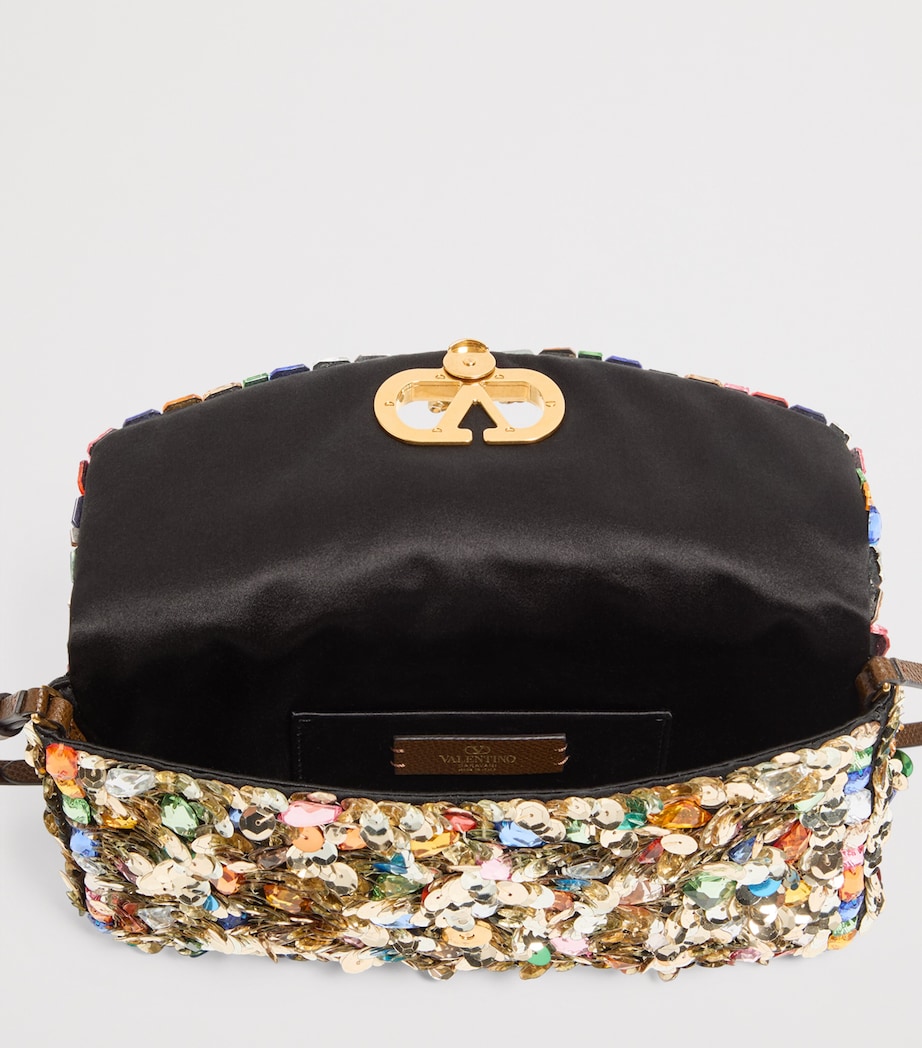
Valentino Garavani concentrates its deepest choice in shoulder bags. The shoulder shelf, read through what is actually orderable in 2026, is the widest the house currently runs, extending from just under two thousand dollars to almost eight. Because that range holds four or five genuinely different design ideas rather than one idea in four sizes, a side-by-side comparison tells you more than a category round-up. The families that follow are weighed on the three things that matter when choosing: what defines the shape, what it costs at observed 2026 market prices, and who it suits. These figures were observed in the market during 2026 research rather than drawn from an official price list, and they shift, so treat them as position markers rather than quotes.

The logic behind the comparison

Most of the pricing in this category reduces to one rule, worth spelling out before any single model. Valentino sets shoulder bag prices by material and embellishment much more than by size. The proof sits inside DeVain, where a DeVain small shoulder bag in jacquard lurex was observed at $2,100 while a DeVain small shoulder bag in metallic mesh was observed at $3,900. The same family and the same size description, eighteen hundred dollars apart. VSling delivers the same lesson from the other direction: a mini set with pearls and rhinestones at $6,550 costs nearly double a small in grainy calfskin at $3,350. The practical instruction is simple: set entry prices against entry prices below, and take every top figure as a statement about surface decoration rather than about capacity.

Rockstud: the most affordable entry to the shoulder shelf

The category starts at the Rockstud small shoulder bag, observed at $1,950 in suede valentino mini bags and $2,100 in grainy calfskin, the only family here that starts below two thousand dollars. Its case is recognisability. The studs themselves go back to Fall 2010, launched under then co-creative directors Maria Grazia Chiuri and Pierpaolo Piccioli on footwear before anything else and drawing on the rusticated stonework of Roman architecture. Rockstud is likewise the deepest line in the current range at roughly fifty-two live pieces, which places the shoulder bag inside a full family of wallets, crossbodies and totes. Compared with the newer families it comes across as the least fashion-forward option and the most durable choice. Anyone wanting a valentino shoulder bag that still reads correctly in five years has the conservative pick right here.

DeVain: the material-led family

If you want to understand how this house handles surface, DeVain is the family to read. In 2026 the observed spread extended from $2,100 for a small shoulder bag in jacquard lurex to $3,900 for a small shoulder bag in metallic mesh, and material drives all of that difference. That makes DeVain the most unpredictable family in the comparison, because two pieces sharing a name can land in completely different parts of your budget. Patience pays here, because the less expensive materials give the shape at close to Rockstud money. This is where buyers who want something less declarative than studs generally finish up. Against that, textile and mesh surfaces are less forgiving than calfskin and more difficult to refresh once scuffed.

Rockstud Spike: the wide middle

Rockstud Spike sits at the centre of the shoulder shelf, covering the widest run of the mid band. Starting around $2,550 for a small in suede, observed prices pass through $2,750 to $3,200 for medium suede, $2,800 for a small nappa and $2,950 for a medium in kidskin, before topping out at $3,500 for a medium nappa and $3,700 for a medium in embroidered nappa. That is six material and size combinations in one family, so the Spike ladder functions as a materials menu at largely fixed silhouettes. Set beside Rockstud proper, the reasoning is straightforward: several hundred dollars more for a more decorative treatment. Locò is easy to place too: it starts where Spike is already well into its range. Anyone wanting one bag placed squarely in the commercial core of the house will find the most routes to it here.

Locò: the longest price ladder here

Locò, spelled with the accent as part of the name, has the longest price ladder of any current shoulder family. Observed 2026 prices begin at $2,700 to $2,950 for a small in calfskin, move through $3,100 for embroidered linen and $3,200 for laminated calfskin with a jewel logo, reach $3,350 for the jewel logo treatment, then climb to $4,700 and $5,100 embroidered and $5,900 set with pearls and rhinestones. In other words, the same design can cost twice as much depending only on how it has been finished. That makes Locò the family where the entry pieces and the flagship pieces feel like different purchases entirely. Resale works in its favour here: a VLogo Locò flap shoulder bag was tracked at 57 percent retention against a house average near 41 percent. If you judge a valentino garavani bag on more than looks, that is the figure to note.

Panthea: where the range ends

With Panthea the house stops competing on price. The observed 2026 run starts at $3,800 for chevron nappa or suede, passes $5,650 in python and $7,600 in ostrich, and ends at $7,900 for an embroidered version, so Panthea is the most expensive bag family in the current line-up. Everything above the entry price reflects exotic skin or embroidery rather than size or hardware. That puts Panthea in a different conversation from the rest of this comparison, because it is not the practical answer to anything and is not meant to be. Exotic skins also impose obligations after purchase, because python and ostrich need professional care and cannot be treated at home the way calfskin can. Panthea versus Locò is really the difference between a statement object and a bag you will use.

VSling, VLogo Signature and the discontinued names

Two further families belong in the field. VSling is defined by its sculptural V-shaped metal handle and closure, with observed 2026 prices from $3,350 for a small in grainy calfskin, through $3,600 to $3,850 with a jewel logo and $5,600 to $6,000 for a mini embroidered version, up to $6,550 for a mini set with pearls and rhinestones. VLogo Signature sits at the opposite end and is the cheapest way into the house, with a mini bag or mini bowling bag observed at $1,750 and a mini bucket at $1,450. Then there are names that fill search results but cannot be bought new: Roman Stud, One Stud, Supervee, Escape and Stud Sign are absent from the brand’s current filters, and a small Roman Stud handle bag observed at $3,550 was flagged as a reserved product rather than an orderable one. Put the whole group in archive or resale territory. Knowing which list a name belongs to saves a great deal of wasted searching.

The families at a glance

The table assembles the current shoulder families at prices observed during 2026 and names the defining element of each. Two things jump out. First, entry prices cluster, leaving the decision at the bottom of each family far closer than the headline ranges suggest. Second, the tops scatter, as embroidery, crystals and exotic skins do all the work above the mid band. Everything here stays observed 2026 market prices rather than an official price list. Read the left one as what the design costs and the right as what the finish adds.

Family name What defines it Range observed in 2026 (USD) Which bands
VLogo Signature (mini) V emblem as both hardware and closure $1,450-1,750 Entry into mid
Rockstud (small shoulder) The pyramid studs $1,950-2,100 Mid band
DeVain Material-driven small shoulder $2,100-3,900 Mid into top
Rockstud Spike Studs across six material options $2,550-3,700 Mid into top
Locò Flap shoulder, jewel and embroidered finishes $2,700-5,900 Mid to top
VSling V-shaped metal handle, sculptural $3,350-6,550 Mid into top
Panthea Chevron nappa, plus python and ostrich $3,800-7,900 The top band

Which one, and who for

Compressed to a line each, the choice looks like this. Rockstud fits the buyer chasing the most recognisable signature at the lowest shoulder price. DeVain is for the buyer who wants something less obvious and will choose the material carefully. Rockstud Spike is for the buyer who wants the widest choice in the commercial core. Locò is for the buyer who wants the strongest resale record and a ladder that reaches decorative pieces. Panthea suits the buyer who is not price-shopping at all. One warning holds across all of them: check which company made the bag before you check whether it is authentic, because Valentino S.p.A. and the separate, unrelated Mario Valentino S.p.A. of Naples both sell bags, and only the couture house’s pieces carry VALENTINO GARAVANI on the interior tag.

Y2K Street Tee Godspeed NY Denim Online

Posted on: 09.27.26 By client

Identifying the Real Godspeed Store and Filtering Out the Lookalikes

One search on the brand name and the result is anything but a single store. What arrives instead is a cluster of storefronts: the official Godspeed store is claimed by nearly all of them, a large share repost near-identical product photography, and one tidy founding story recurs on nearly all of them. Roughly eighteen such sites were tallied during research in September 2026, which is an uncommon density even by streetwear standards. None are named here, because naming them is the free advertising they are designed to collect. Any storefront can be run through the checks below in minutes, and they call for only what is right there in front of you. Whichever storefront you clicked into, the tests work, and they outlast the turnover of today’s lookalikes.

Why the Copycats Collect on This Particular Name

Two factors make this particular label appealing to imitators. Search ambiguity comes first, because godspeed is an ordinary English word with a dictionary entry, so the traffic comes in largely undirected and simple to intercept. Not everyone searching god speed clothing, godspeed shirts or the name alone wants the same thing, and a lookalike only needs the ones who do. The second reason is the label’s own silence, and that gap gets packed with fabricated detail by copies. Without a circulated founder interview, a press-kit history or an official explanation of the graphics, an invention runs into nothing that corrects it. That is the soil in which fake official stores flourish exactly where demand is generic and heavy while official signal is thin.

Test One: An Origin Story Nobody Can Verify

Nothing exposes a copy faster than a assured founding narrative. A named founder, a founding year and a rebrand from an earlier name: multiple copycat shops state all three as settled fact. None of that traces back to the brand. The company’s own site publishes no origin story; the About section was still holding placeholder Lorem Ipsum text when the research was done, strange yet verifiable. The lesson when a page out-histories the brand itself is something about the page rather than about the label. Until it is put in the label’s own words, treat every founder name, rebrand claim and founding date as unsourced, all the more because the identical paragraph repeats verbatim across them.

Check godspeed new york Two: The Wrong Company’s Founders

There is a second, less obvious version of the same mix-up, and it snares even legitimate retailers. Entirely separately, an American business called Godspeed Co. manufactures garage and motorcycle goods and states its founder names openly; it has no link with the New York streetwear label. It is documented, not conjecture: that company’s three founders have been attributed in retail copy, more than once, to the NYC brand whose tees and hoodies is on the page. The tell is obvious once you know it: a page selling puff-print streetwear that veers into American-made workwear values has copied from the wrong source. That is not proof of fraud, since established stockists have slipped the same way. Compiled, not reported: that is what the brand copy is, and the same doubt belongs on its other claims.

Signal Three: Impossible Prices and What They Tell You

Price does the fastest work, because it is the one signal you can put a number on. Here are the observed 2026 market estimates: t-shirts at roughly $128 to $200, hoodies at about $200 to $270, sweatsuits and sets from $155 to $360, shorts at $120 to $200, cargo pants around $350, premium denim at $250, headwear from $60 to $150, belts at $250, slides at $160 and watches at $80 to $100. When a storefront advertises current-season pieces at a fraction of those bands, one of two things is true: there is no such stock, or the goods are not the same. For a brand producing small numbered batches, sitewide discounts of seventy or eighty per cent make no commercial sense, given that scarcity makes discounting pointless. Watch just as closely for the reverse, where one flat price covers everything regardless of category. Run the list below against whatever page you are looking at.

  • A godspeed hoodie listed far under the $200-270 band with nothing said about why.
  • The same price across tees, denim and outerwear, something real category structure never produces.
  • Timers that always restart, or a catalogue-wide sale with no end.
  • A currency or shipping setup that do not belong to a New York-based, USD-priced operation.
  • Product names that line up with no named collection or graphic families the label actually uses.

Check Four: Watching the Checkout Itself

Most of what you need shows up before any money moves. On a legitimate storefront checkout is a secure affair: a padlocked connection, a clear order summary, tax and shipping calculated before payment, mainstream payment options. Warning signs include a checkout that asks for bank transfer, crypto, gift cards or a direct app payment to a person, since the chargeback protection card payments carry is removed. A checkout asking for more than a clothing order needs is another red flag, for instance identity documents or unrelated account credentials. A page that redirects you off-site to complete payment under different branding is where the check ends. Do not enter card details to test whether a site is legitimate; check some other way and walk away from the cart. That failure answers everything.

Signal Five: The Unglamorous Pages: Contact, Policies and Copy

Few people read the dull pages, which is exactly why copies neglect them. What you want is a working, specific contact route rather than a web form alone, plus returns, exchange and shipping policies that name real timeframes and read as if garments were involved. Nothing reads worse than template policy text, complete with placeholder phrases or mismatched company names. The product copy obeys the same rule, since the genuine catalogue names its techniques precisely: puff print, heavy embroidery, named garment washes, 3M reflective detailing, wool bodies with vegan-leather or vegan-suede varsity sleeves and heavyweight fleece. Vague adjectives, the same text block repeated across unrelated products and translation errors are the copy’s usual output. Check too whether the acronym graphics are given confident meanings: the label does not publish what R.O.D, I.G.W.T, F.T.D, G.R.C or VVS stand for, so any page claiming to know is filling in blanks.

The Cross-Check Worth Doing

The strongest verification skips judging a website altogether: it means triangulating against parties with a reputation to lose. Wholesale is part of the picture: stockists carrying it in 2026 included FEATURE, TAKOUT NY, Tops and Bottoms USA, Civilized Nation, Premium Lounge NY, NRML in Ottawa, Farfetch and GOAT. Those retailers have their own returns processes and customer-service obligations, protection a mystery storefront cannot match. Add resale to that: a StockX brand page with around forty apparel entries, lowest asks observed between roughly $75 and $297, and listings on Grailed and eBay. Nothing else carries it: its existence rests entirely on one seller’s word. Below, each signal appears in both directions, reassuring and worrying.

What to check Reads well Reads badly
Brand backstory Either no origin story, or one openly flagged as unverified A specific founder, a founding year and a rebrand story that repeat verbatim on other sites
Who the brand actually is NYC streetwear described in its own terms A different firm’s founders, or garage and moto heritage, bolted onto it
What it costs Within the observed 2026 range for the category Deep discounts across the site, or a single flat price across every product
Payment step Secure connection, ordinary card options, all costs visible before payment Transfer, crypto or gift-card payment; off-site redirect at the last step
Product copy Names real techniques, washes and collections Assured acronym meanings plus generic text reused throughout
Presence elsewhere The piece is visible at known stockists and on resale too Exists on that single storefront and nowhere else at all

A Five-Minute Verification Sequence

Sequence the tests and the check gets short enough to do on every purchase. Reading alone gets you through the first pass, and cross-reference only what survives. Most imitations do not survive step two: the founder paragraph or the pricing does it. Where a page clears every test but doubt remains, buying the same godspeed shirt from a named stockist costs slightly more and ends the question. Keep the paperwork: keep order confirmations, record the payment method, and remember that card payments are the only route that reliably supports a dispute. The sequence below is the one to keep in your head.

  1. Begin at the About or history text, looking for a named founder, a founding year or a rebrand.
  2. Compare listed prices against the observed 2026 bands for that category.
  3. Go to the returns, shipping and contact pages and hunt for real, specific, non-template detail.
  4. Stopping short of payment, carry one item to checkout and inspect the payment options and the connection.
  5. Hunt the same design across known stockists and resale platforms, confirming it exists elsewhere.
  6. Should any two steps fail, buy from a stockist and treat the storefront as unverified.

Urban Fashion Set 100% Authentic

Posted on: 09.27.26 By client

Key Palm Angels Clothing Every Street Style Enthusiast Should Have

Creating a street-style closet is a lot like curating an fine art collection — you want pieces that resonate with you individually, hold their value over time, and interact to communicate a cohesive narrative about who you are. Palm Angels, the Italian luxury streetwear force established by Francesco Ragazzi, creates some of the strongest individual pieces in the game right now, and understanding which ones earn your money can help you avoid regrettable buys that sit unworn in the far corners of your storage. The brand sits at an interesting intersection in 2026: known enough to have authentic credibility, but nevertheless ambitious enough in design terms to keep pushing boundaries each season. With the worldwide streetwear market worth approximately $187 billion and expected to reach $230 billion by 2030 according to Grand View Research, spending on the smart pieces has never been more important. This isn’t a catalog of everything Palm Angels makes — it’s a thoughtful selection of must-haves that deliver peak impression, range, and sustained value.

The Track Jacket: Your New Everyday Layer

If you just invest in one Palm Angels piece in your entire life, go for the zip jacket. This is the one garment that most accurately represents what the brand does — transform a piece rooted in sports contexts, elevate it with Italian manufacturing and recognizable design, and produce an piece that succeeds in more situations than you’d think. The standard version has the full-zip closure, standing collar, and iconic contrast side stripes going from shoulder to cuff, all constructed https://palmangelsshorts.com in a sleek synthetic-mix knit that hangs neatly. It functions over a basic tee with trousers for a easy meal, worn under a overcoat for a cold-weather evening, or worn with matching track pants for a coordinated set. The weight of the textile is solid enough for light warmth but thin enough to stack without weight. At $350 to $500 retail, it represents one of the stronger value propositions in the Palm Angels lineup when you account for cost-per-wear. The Spring/Summer 2026 range introduces a vintage-washed olive and a cream-and-black combination generating advance buzz on online forums.

The Statement Hoodie: Street Style’s Big Play

Why Every Wardrobe Needs a Bold Hoodie

Hooded tops are the backbone of any urban fashion closet, and Palm Angels designs some of the most impressive options at any price. The label’s graphic hoodies have bold designs that serve as walking art without veering into costume-like territory. The teddy bear print sweatshirt continues as the most coveted iteration, with the deconstructed teddy bear design changing each year while maintaining recognizable character. For SS26, highlight options include a spray-paint bear in electric blue and a vintage photograph sweatshirt featuring Ragazzi’s foundational LA skate photographs. The quality lives up to the creative boldness: dense 380 GSM brushed-back fleece, double-stitched shoulder seams, two-layer hood with a heavy tie, and ribbed cuffs and hem. Silhouette is relaxed but not too large. Prices range from $400 to $600, providing real quality superiority over alternatives at the same price point. The hoodie is the item people will notice first and inquire about most.

Styling the Hoodie Further Than Simple Combinations

Owning a great sweatshirt is one thing; wearing it well is different. The most common error is matching Palm Angels statement hoodies with matching-statement lower pieces, building cluttered looks rather than balance. The golden rule: the bolder the top, the more minimal everything else should feel. A bold printed design works best with clean black joggers or slim denim, clean sneakers, and minimal extras. On the other hand, a understated sweatshirt can accommodate more adventurous pants — cargo pants, patterned trousers, or structured shorts in summer seasons. Layering a sweatshirt beneath a structured jacket creates tension between street and polished that comes across as style-aware in 2026. The hood itself acts as a styling element: worn up with eyewear for an incognito aesthetic, or back to show off a necklace beneath. For women’s styling, the oversized Palm Angels sweatshirt worn as a dress with thigh-high boots has become a street style classic.

Classic Logo Tee: The Essential Item

No street style wardrobe is whole without excellent logo t-shirts, and the Palm Angels classic tee earns a spot in that collection permanently. This is your everyday staple — the item that works with all of it and still shows style literacy without shouting. The brand name across the chest is recognizable enough to be spotted by knowledgeable people while remaining understated enough for occasions where a large design would feel excessive. The cotton quality is excellent: a heavyweight single-jersey weave in the 190–210 GSM bracket that prevents size reduction, neck stretching, and bobbling. The cut is “regular relaxed” — enough ease for comfortable activity without shapeless bagging. Offered all year in standard colorways (black, white, navy, medium grey) plus collection-specific options, this tee grounds casual looks, goes under blazers, and even fits into trousers. At $250 to $320, compare it to tees at the same cost from Givenchy or Balenciaga, and Palm Angels’ material weight usually wins on measurable factors.

Track Bottoms: Ease That Earns Admiration

The matching partner to the sports jacket, Palm Angels joggers deserve their own place because they perform brilliantly as independent items past the matching set use case. The lateral-stripe detail builds a lengthening effect that complements virtually every body type, while the tapered silhouette from thigh to gathered ankle band gives a neat, current silhouette that works with nearly any sneaker pick. The elastic waistband with internal cord provides full-day comfort that button-fly pants simply cannot achieve. The smooth polyester-blend material withstands fold marks — perfect for travel and long days where you need to appear well-dressed without regular upkeep. Combine them with a clean sweater and clean trainers for effortless casual fashion, or dress them up with a knit polo and loafers for a surprisingly dressed-up summer outfit. The black color option with clean white stripes is the key first choice, but collection-specific releases in burgundy, bottle green, and navy satisfy those who explore further than the obvious. At $320 to $450, these are the most comfortable “real pants” you will own, and the compliments-to-effort equation is practically unmatched.

Starting Your Palm Angels Foundation Collection

With a full sense of the essentials, the practical decision turns to: what to purchase first? Ahead is a planned shopping sequence that maximizes closet impact at each point.

Priority Piece Approx. Cost Versatility Reason to Buy First
1 Classic Logo Tee (Black) $275 10/10 Wearable daily, lowest entry cost
2 Track Jacket (Black) $425 9/10 Three-season versatility, brand signature
3 Track Pants (Black) $375 9/10 Completes the set, standalone strength
4 Graphic Hoodie $475 8/10 Statement piece, cold-weather anchor
5 Classic Logo Tee (White) $275 10/10 Doubles tee rotation

Going with this approach, you’d spend roughly $1,825 to put together a solid Palm Angels foundation — these five pieces work together to generate many of varied looks across all four seasons. Each item was chosen for top interoperability: the zip jacket pairs with jeans, the hoodie pairs with the track bottoms, the graphic tees layer under everything. Shopping thoughtfully during end-of-season markdowns at SSENSE or Farfetch can reduce that spend by 25–40%, and the secondary market on Grailed offers legitimate pre-owned choices at 30–50% below full price. The point isn’t to purchase everything at once — it’s to buy smartly, enjoy often, and build a collection that works for you for the long term rather than a short time.

Washed Wreath Denim Tears Denim Tears Sweatshirt

Posted on: 09.27.26 By client

Authentication Guide: How to Check a Denim Tears Hoodie Properly

Counterfeit runs follow demand, and demand has stayed high since Tremaine Emory founded Denim Tears in 2019 and the cotton wreath became one of streetwear’s most recognisable graphics. That popularity has produced a steady supply of replicas, some crude and some careful. No single detail authenticates a garment on its own, which is why guides promising one magic check tend to mislead people. Accumulation is what works: seven separate observations which either agree or start to contradict. All of it below is visible, tactile or measurable, without special equipment or any claimed insider knowledge. Run the checks in sequence, since the first few frequently settle the matter before the rest are required.

Check 1: Vet the Seller Before You Examine the Hoodie

The seller is the strongest single signal available, so the work really begins before the parcel arrives. Check the age of the account, its completed sales, and whether the feedback relates to the same category of goods. An account two weeks old, a dozen identical listings, every size covered — that behaves like a replica wholesaler rather than a person emptying a wardrobe. Request extra photographs taken for you, preferably alongside a handwritten note showing the date, because denim tears brand counterfeit sellers reuse stock images. Pay attention to how they answer as well: a genuine private seller will say where and roughly when they bought it, while a replica seller deflects into vague reassurance. A platform with its own physical authentication step carries some of the risk for you, although none of them is infallible.

Check 2: Read the Cotton Wreath Print Up Close

Patient inspection pays off on the wreath graphic, because it is the hardest element to reproduce well. On a well-made piece the print lies flat and even across the chest without ripples, and the edge of each shape stays clean rather than feathering into the fleece. Check for consistent ink density, because thin patchy areas or a chalky surface suggest a cheap single pass on a badly set up machine. Look at the colour separation too, confirming that adjacent tones meet crisply instead of bleeding together. Put a hand on the print: good screen work has some body but stays flexible, while a stiff plastic slab that lifts at the edges is a warning. Finally, compare placement and scale against several confirmed retail photographs, since replicas often print the graphic slightly too large or an inch too high.

Check 3: Weigh the Fabric and Check the Interior

Genuine pieces at this price are made from substantial fleece, and weight is among the least forgeable properties of a garment. Expect a dense hand around 12 to 14 oz, roughly 400 to 480 gsm, clearly heavier than a 280 gsm high-street denim hoodie. Turn the garment inside out and study the interior, where quality loopback or brushed fleece shows an even dense texture rather than a thin layer that pills under a fingernail. Hold a panel up to the light, since cheap cloth passes more light and shows a loose, irregular knit. Drape matters too, since heavy fleece hangs with real weight instead of clinging or floating. Should a hoodie costing hundreds feel like a promotional sweatshirt, take that impression seriously.

Check 4: Make the Labels Prove Each Other

Internal consistency is where replicas usually fail, so test the labels against each other instead of memorising details you have no way to check. Every label on one garment should share the same production logic: matching stitch quality, matching material, matching print sharpness. A crisp neck label sitting next to a blurred, crooked care label is the kind of contradiction genuine production rarely produces. Read the care and content information and check that it matches the garment in your hands, since a fibre composition at odds with the actual cloth is a serious problem. Check that the labels sit straight, are properly caught in the seam, and do not fray under gentle handling. Read the typography as well, not for secret codes but for ordinary tells such as uneven spacing, wrong-looking weight and misspelled words.

Check 5: Check the Seams and Every Small Component

Begin with the cuffs, hem, armholes and pocket openings, because construction quality declares itself wherever a garment takes strain. Stitch density should hold steady along a whole seam, without stretches of loose, wandering or skipped stitches. Check for reinforcement at the obvious points, especially at the ends of the kangaroo pocket where hands pull hardest. Flip the garment inside out and check the seam allowances are cleanly finished instead of raw and dropping threads. Small components deserve the same attention, so confirm the drawcord tips are properly fixed instead of glued and lifting, and that the eyelets sit flush and even without splitting the surrounding fabric. Pull the cuff ribbing gently: it ought to spring back immediately rather than hanging loose.

Check 6: Check the Measurements Against the Promised Size

Measurements are objective, and counterfeit patterns wander, since they are traced from photographs instead of specifications. Lay the hoodie flat and measure pit to pit across the chest, then collar base to hem for length, then shoulder seam to cuff for the sleeve. Compare those figures against published measurements for the same nominal size, allowing a tolerance of about half an inch, or one to one and a half centimetres. A large that measures three inches narrower than expected is not natural variation, it is a different pattern. Measure both sleeves too, since mismatched lengths indicate careless cutting. Apply the same test to denim tears jeans or to the sweatpants many shoppers search for as denim tear pants, because the same logic applies right across the catalogue.

Check 7: Give Packaging and Paperwork the Least Weight

Use tags, dust bags, cards and printed receipts to confirm a conclusion, never to build one, because they are the easiest things of all to fake. They remain informative when their quality clashes with the garment, such as a flimsy tag on an otherwise well-made piece. Check that any hang tag hangs where you would expect and has not been reattached through a fresh hole in the fabric. Distrust screenshots of order confirmations: editing them is trivial and the same ones circulate across many listings. A paper receipt from a recognised stockist counts for a little more, though it still only proves that someone bought something at some point. Give all of it about ten percent of the decision, and let fabric, print and construction carry the rest.

A Quick Green Flag and Red Flag Comparison

The table condenses those checks into a comparison you can run in a few minutes. Treat it as a scoring sheet, not a pass-fail test, by tallying the rows that fall on either side. One ambiguous row on an otherwise strong garment is normal, since real production always involves natural variation. Once three or more rows sit in the right-hand column, stop the purchase. A good counterfeit is built to pass some of these rows, which is exactly why the running count matters more than any single line. When you cannot inspect a piece in person, ask for detailed photographs of every area listed here before any money moves.

Area checked Points to a genuine piece Common red flag
Fabric weight Substantial fleece, roughly 400 to 480 gsm Thin and light, translucent under light
Edge quality of the print Neat edges, even ink density, supple to the touch Feathered edges, patchy or plasticky
Labels Uniform quality from one label to the next Inconsistent print, crooked seating, early fraying
Seam work Even density, reinforced stress points Skipped stitches, loose thread ends
The measurements Within about 0.5 in of published specs Out by 2 in or more, plus mismatched sleeves
Price Close to the 2026 market range A long way under any credible estimate

If the Hoodie Is Already in Your Hands

Speed counts for more than anger here, since a problem discovered after payment is frustrating yet seldom hopeless. Record everything first, because your evidence weakens the moment the garment is worn or washed. Most marketplace protections run on short windows measured in days, so establish the deadline before any negotiation starts. Keep the conversation on the platform, because shifting to private messages generally voids buyer protection. Stay factual and cite specific observable defects instead of general suspicion. What follows is the sequence that tends to work.

  1. Shoot the print, labels and seams, plus a tape measure across the chest.
  2. Do not wash or wear the garment, and keep every part of the packaging.
  3. Open a formal dispute before the return window closes.
  4. Give specifics — measurements two inches off spec, say.
  5. Escalate to your payment provider only after that process finishes.

Authenticating a denim tears hoodie is a discipline rather than a trick. Deal with sellers whose behaviour is transparent, judge the garment on fabric, print and construction, and weigh paperwork last. A history that deserves accurate representation sits behind the cotton wreath, and counterfeiting serves neither the history nor the buyer. Put in the extra twenty minutes, and a search for denimtears ends with a piece you can wear without doubt.

Urban Dubai Practice Explaining The Full Design Process

Posted on: 09.27.26 By client

Villa Interior Design in Dubai: How to Choose a Long-Lasting Style

A villa is somewhere you stay for years, the interior style you settle on has to survive years of daily life and shifting trends In Dubai, where a luxury villa fit-out can mean a significant investment, choosing the wrong aesthetic is an expensive mistake to unwind The temptation is to chase whatever look dominates this season, but the styles that age best are rooted in proportion, material quality and restraint Rather than a mood board, this guide is a decision framework, explaining the main villa styles, judging their staying power and helping you match one to your home and budget It draws on how Dubai’s residential studios approach the question in 2026 By the end, you should be able to brief a designer with confidence rather than a stack of clippings

Why picking a style matters especially in a villa

An apartment refresh is relatively easy to redo, but a villa commits you to a style across far more space, cost and time As a 2026 market estimate, a mid-range villa interior runs roughly AED 250,000 to 600,000, while luxury and ultra-prime homes on Palm Jumeirah or in Emirates Hills climb to AED 600,000 to well over AED 2 million At those sums, a style that dates in three years is a costly liability, not a minor annoyance Villas also carry more architectural personality than apartments, so the interior has to work with the building rather than against it Larger footprints mean decisions about flooring, joinery and stone repeat across many rooms, multiplying the impact of any misjudgement Picking a durable style protects both your day-to-day pleasure in the home and its resale appeal

The main villa styles to consider

Most Dubai villa briefs settle into one of a few broad style families, each with a different relationship to longevity The four below cover the majority of projects and can be blended thoughtfully rather than treated as rigid boxes For each, it is worth taking time to weigh how well it will read in five or ten years, not just on https://www.interiordesigndubai.org/ handover day Think about maintenance too, as some looks demand more upkeep to stay convincing The sections below set out each style, its strengths and its risks Studios including ALGEDRA Interior Design, CK Architecture Interiors and Sneha Divias Atelier span this spectrum

Contemporary and warm minimalism

Contemporary minimalism strips interiors back to clean lines, open volumes and a restrained palette, and its warmer 2026 evolution softens that with natural textures This family ages well because it relies on proportion and material quality rather than decorative trends that date quickly Warm minimalism in particular, with its sand tones, timber, stone and linen, suits Dubai’s light and feels current without being cold The risk is that poorly executed minimalism can read as bare or unfinished, so detailing and craftsmanship carry the whole look It also shows dust, marks and clutter more quickly, requiring disciplined storage and upkeep For owners who value calm and longevity, it is one of the safest long-term bets

Modern classic and neo-classical

Neo-classical interiors bring symmetry, mouldings, rich materials and a sense of formal grandeur that many Dubai villa owners associate with luxury Firms such as Luxury Antonovich Design are associated with this ornate, palace-scale end of the market Its strength is a timeless, established language that rarely looks fashionable and then dated, because it references centuries-old proportions The danger is over-ornamentation, since heavy gilding and busy detailing can slip from elegant to dated if pushed too far A modern-classic take, meaning classical bones with a lighter, calmer palette, tends to age better than full ornamentation This style also carries higher material and joinery costs, so budget accordingly

Contemporary Arabic and Arabesque

Contemporary Arabic design reinterprets regional heritage, including mashrabiya screens, geometric patterns, arches and courtyards, in a modern and pared-back way It resonates strongly in Dubai because it connects a home to its cultural setting rather than importing a generic global look Handled with restraint, it ages gracefully, since the motifs are rooted in tradition rather than fashion The pitfall is theming, because overusing the same patterns can turn a sophisticated interior into a pastiche The most durable versions deploy one or two strong regional gestures against a calm contemporary backdrop This style suits owners who want a sense of place without sacrificing modern comfort

Organic modern and biophilic design

Organic modern draws on natural materials, curved forms, greenery and a strong indoor-outdoor connection, aligning closely with the wellness and biophilic trends of 2026 It ages well because nature-led palettes and textures rarely feel dated, and the emphasis on light and planting supports daily wellbeing Dubai villas with gardens, courtyards or pool decks are natural candidates for this approach The main risk is trend-chasing at the edges, since very specific furniture shapes or finishes can date even when the core idea does not Keeping plants and natural materials in good order also takes commitment to keep the look convincing For garden-rich villas, it is one of the most future-proof directions available

How to choose a style that lasts

With the main families laid out, the decision comes down to matching style to home, household and budget Start from the architecture and work with the villa’s proportions and light rather than forcing a look that fights them Weigh your household’s real life, since minimalism and young children, for instance, demand serious storage discipline Factor in maintenance appetite honestly, because every style has upkeep implications Keep an eye on resale, choosing restraint over highly personal statements if you may sell within a few years The points below reduce the decision into practical filters

  • Align the style to the villa’s architecture, light and outdoor spaces
  • Choose proportion and material quality ahead of decorative trends that date
  • Choose one dominant style and use others only as light accents
  • Budget realistically, earmarking 10 to 20 percent of project cost for design fees as a 2026 estimate
  • Plan storage and maintenance around how your household actually lives

Pairing style to villa and budget

The table below lines up each style family with the villa types and budget bands it tends to suit It is a starting filter, not a rule, since skilled designers blend styles successfully every day Budget figures are 2026 market estimates that move with size, materials and specification The longevity column reflects how well each look typically holds up, assuming disciplined execution Read it alongside the decision filters above rather than by itself Your architecture and household should always override a generic match

Style family Best for Staying power 2026 villa budget (est.)
Warm minimalism Modern villas, calm-seekers Very good AED 250,000 to 900,000
Neo-classical / modern classic Grand, symmetrical villas High if restrained AED 600,000 to 2M+
Contemporary Arabic Owners after a sense of place High with restraint AED 300,000 to 1.2M
Organic modern / biophilic Garden and courtyard villas High AED 300,000 to 1M

Making a confident decision

Choosing a villa style that lasts is less about prediction and more about principles that outlive any single season Anchor the interior in proportion, quality materials and restraint, then let one style family take charge with the others as quiet accents Match that choice to your villa’s architecture, your household’s daily reality and your honest maintenance appetite Respect the budget bands, with mid-range from around AED 250,000 and luxury well beyond AED 600,000 as 2026 estimates, and set aside design fees of roughly 10 to 20 percent of cost Brief your chosen studio on longevity as an explicit goal, not just on look Do that, and the style you pick in 2026 will still feel right long after this year’s trends have moved on

Casablanca Clothing Travel Spirit Just Added Today

Posted on: 09.27.26 By client

The Birth of the Casablanca Label

Charaf Tajer, a French-Moroccan designer famous for the club Le Pompon and the streetwear brand Pigalle, founded the Casablanca fashion house in 2018. Instead of continuing along a exclusively street-focused trajectory, Tajer decided to establish a luxury brand that blended the positive energy of resort culture with the refinement of Parisian high-end fashion. He picked the name Casablanca as a deliberate tribute to the Moroccan metropolis where his family roots originate, a city known for warm light, decorative tiles, palm-shaded streets and a laid-back pace of life. Starting with the inaugural collection, the brand stood apart from traditional streetwear by embracing vibrant colour, artwork and narrative over sombre colours and tongue-in-cheek graphics. The first items—silk shirts featuring hand-illustrated tennis imagery—immediately indicated a new vision: to dress people for the best moments of their lives rather than for city toughness. By 2020, the Casablanca fashion house had already landed retail outlets in Paris, London, New York and Tokyo, showing that the vision resonated well beyond its creator’s inner circle.

How Charaf Tajer Moulded the Brand’s Identity

Charaf Tajer’s biography is fundamental to understanding why Casablanca looks and feels the way it does. Raised between Paris and Morocco, he internalised two distinctly different aesthetic traditions: the sleek sophistication of French fashion and the vivid colour of North African art, architectural design and fabrics. His years in the nightlife scene showed him how garments functions as a means of individual expression in social settings, while his experience at Pigalle demonstrated to him the business mechanics of developing a brand with international recognition. When he launched Casablanca, Tajer combined all of these influences together, designing clothes that feel joyful rather than aggressive. He has shared publicly about desiring each collection to embody “the feeling casablanca clothing sale of winning”—a mood of elation, self-assurance and comfort that he connects to sport, journeys and camaraderie. This emotional clarity has afforded the Casablanca house a unified story that shoppers and journalists can immediately connect with, which in turn has fuelled its climb through the fashion hierarchy. In 2026, Tajer stays on as the creative director and keeps overseeing every important design decision, making sure that the label’s identity stays steady even as it grows.

Design Codes and Visual Language

Casablanca’s aesthetic is constructed around several overlapping elements that make its garments instantly recognisable. The most striking is the utilisation of oversized, hand-drawn illustrations depicting Mediterranean and Moroccan vistas, tennis courts, motorsport imagery, tropical flora and architectural details. These illustrations are rendered in saturated pastel tones and jewel-like hues—consider peach, mint, cobalt, emerald and gold—and transferred onto silk shirts, dresses, scarves and outerwear so that each item resembles a moving postcard from an fictional holiday destination. A another pillar is the blend of sport-inspired cuts with luxury materials: track jackets come in satin with piped seams, sweatpants are cut in premium fleece with refined finishing touches, and polo shirts are produced in fine cotton or cashmere blends. A further code is the use of emblems, monograms and sporting-club logos that allude to tennis and yachting without imitating any actual organisation. Collectively, these pillars produce a realm that is invented yet intensely compelling—a domain where sport, art and relaxation merge in eternal sunshine. In 2026, the label has expanded these principles into denim, outerwear and leather goods while retaining the design language unmistakable.

The Importance of Colour and Prints in Casablanca Collections

Colour is likely the most essential instrument in the Casablanca design vocabulary. Where many luxury brands fall back on black, grey and understated hues, Casablanca consciously picks colours that evoke comfort, delight and dynamism. Each season’s colour story often originate from a inspiration board of travel photographs—Moroccan patios, the French Riviera, lush tropical landscapes—and transform those real-world hues into textile samples that retain vividness after finishing. The result is that even a standard hoodie or T-shirt can feature a shade of sky blue, sunset orange or aquatic turquoise that sets it apart among competitors. Printed designs follow a comparable ethos: each drop presents new visual stories that tell stories about destinations, athletic pursuits and aspirations. Some collectors collect these designs the way others collect art, recognising that earlier designs may not come back. This tactic fosters both emotional attachment and a resale market, underpinning the reputation of Casablanca as a label whose items increase in cultural significance over time. By mid-2026, the brand reportedly earns over 60 percent of its income from printed items, underscoring how vital this component is to the business.

Core Values That Define Casablanca in 2026

Beyond creative direction, the Casablanca brand expresses a clear set of ideals. Joy and buoyancy sit at the top: campaigns and catwalk presentations hardly ever feature dark themes, provocation or edginess; instead they celebrate sunlight, community and slow experiences of delight. Skilled workmanship is an additional foundation—the house underscores the calibre of its fabrics, the clarity of its prints and the diligence exercised during production, above all for knitwear and silk. Cultural dialogue is a third value: by blending Moroccan, French and international influences into every collection, Casablanca operates as a link between worlds rather than a barrier of exclusivity. Finally, the label champions a ideal of diversity through its campaigns, routinely featuring diverse models and presenting garments in ways that work for a broad spectrum of body shapes, age groups and style preferences. These ideals speak to a generation of consumers who desire their purchases to express meaningful principles rather than mere status. In 2026, as the luxury market becomes more competitive, Casablanca’s commitment to emotional storytelling and cultural richness affords it a unique identity that is difficult for competitors to replicate.

Casablanca Versus Major Rivals

Characteristic Casablanca Jacquemus Amiri Rhude
Launched 2018 2009 2014 2015
Headquarters Paris Paris Los Angeles Los Angeles
Signature style Tennis / resort / sport Mediterranean minimalism Rock-meets-luxury street LA vintage sport
Signature piece Silk printed shirt Le Chiquito bag Distressed denim Graphic shorts
Price bracket (shirts) $600–$1 200 $400–$800 $500–$1 000 $400–$700
Colour range Vivid pastels / jewel tones Neutrals / earth tones Dark / muted Vintage muted

The Road Ahead of the Casablanca Fashion House

Gazing into the future in 2026, the Casablanca label is venturing into new product categories while preserving the story that fuelled its rise. Latest collections have unveiled more formal tailoring, leather goods, eyewear and even fragrance experiments, all viewed through the label’s signature perspective of vibrant colour and travel. Partnerships with athletic brands, upscale hotels and cultural venues widen the label’s reach without undermining its core identity. Physical retail development is also underway, with flagship boutique plans in major cities supporting the existing e-commerce website and wholesale partnerships. Business observers project that Casablanca could attain yearly sales of around 150 million euros within the next two to three years if existing growth rates persist, placing it alongside recognised modern luxury brands. For consumers, this course signals more choices, more availability and possibly more competition for limited pieces. The brand’s challenge will be to grow without losing the warm, uplifting atmosphere that captivated its first fans. Eco-conscious efforts, limited-edition capsules and increased investment in direct retail are all part of the plan that Tajer has shared in recent interviews. If Charaf Tajer keeps on treat each drop as a homage to his personal history and ambitions, the Casablanca label is well positioned to continue to be one of the most fascinating stories in the fashion industry for years to come. Interested readers can follow the label’s most recent news on the official Casablanca website or through coverage on Business of Fashion.

Undress Tool Alternative Platforms See How It Works

Posted on: 09.27.26 By client

Prevention Strategies Against NSFW Fakes: 10 Actions to Bulletproof Your Privacy

NSFW deepfakes, “Artificial Intelligence undress” outputs, alongside clothing removal applications exploit public pictures and weak protection habits. You are able to materially reduce your risk with a tight set containing habits, a ready-made response plan, and ongoing monitoring which catches leaks promptly.

This guide delivers a practical ten-step firewall, explains current risk landscape around “AI-powered” adult artificial intelligence tools and undress apps, and gives you actionable ways to harden your profiles, images, and responses without filler.

Who is most at risk alongside why?

People with an large public picture footprint and routine routines are targeted because their photos are easy when scrape and connect to identity. Students, creators, journalists, customer service workers, and individuals in a separation or harassment situation face elevated danger.

Minors and young adults are at particular risk because peers share alongside tag constantly, and trolls use “web-based nude generator” schemes to intimidate. Open roles, online dating profiles, and “digital” community membership increase exposure via redistributions. Gendered abuse shows many women, such as a girlfriend plus partner of one public person, get targeted in payback or for intimidation. The common thread is simple: available photos plus poor privacy equals exposure surface.

How can NSFW deepfakes really work?

Modern generators employ diffusion or Generative Adversarial Network models trained with large image datasets to predict realistic anatomy under clothing and synthesize “convincing nude” textures. Earlier projects like DeepNude were crude; current “AI-powered” undress app branding masks one similar pipeline containing better pose management and cleaner outputs.

These applications don’t “reveal” your body; they produce a convincing manipulation conditioned on personal face, pose, alongside lighting. When a “Clothing Removal Application” or “AI undress” Generator gets fed your images, the output may look believable adequate to fool ordinary viewers. Attackers combine this with doxxed data, stolen direct messages, or reposted images to increase pressure and reach. This mix of authenticity and distribution rate is why protection and fast reaction matter.

The ten-step privacy firewall

You can’t dictate every repost, but you can shrink your attack surface, add friction to scrapers, and rehearse a rapid removal workflow. Treat these steps below similar to a layered protection; each layer provides time or minimizes the chance personal images end stored in an “NSFW Generator.”

The stages build https://ainudez.eu.com from prevention to detection toward incident response, alongside they’re designed when be realistic—no flawless execution required. Work via them in sequence, then put calendar reminders on the recurring ones.

Step 1 — Secure down your image surface area

Limit the raw content attackers can supply into an undress app by curating where your appearance appears and the amount of many high-resolution images are public. Start by switching personal accounts to restricted, pruning public albums, and removing outdated posts that show full-body poses with consistent lighting.

Encourage friends to control audience settings for tagged photos plus to remove individual tag when someone request it. Examine profile and header images; these stay usually always public even on restricted accounts, so pick non-face shots or distant angles. Should you host one personal site or portfolio, lower picture clarity and add appropriate watermarks on portrait pages. Every eliminated or degraded material reduces the quality and believability regarding a future deepfake.

Step 2 — Make your social network harder to collect

Harassers scrape followers, contacts, and relationship status to target individuals or your group. Hide friend lists and follower counts where possible, plus disable public access of relationship data.

Turn down public tagging or require tag approval before a publication appears on personal profile. Lock in “People You May Know” and contact syncing across social apps to avoid unintended network exposure. Keep DMs restricted to trusted users, and avoid “public DMs” unless anyone run a distinct work profile. Should you must keep a public profile, separate it apart from a private page and use different photos and usernames to reduce cross-linking.

Step 3 — Strip metadata and confuse crawlers

Remove EXIF (location, device ID) from images before sharing for make targeting and stalking harder. Numerous platforms strip data on upload, but not all messaging apps and online drives do, so sanitize before transmitting.

Disable camera geotagging and live photo features, which can leak location. When you manage any personal blog, include a robots.txt and noindex tags on galleries to minimize bulk scraping. Consider adversarial “style shields” that add small perturbations designed to confuse face-recognition systems without visibly altering the image; such methods are not flawless, but they add friction. For children’s photos, crop faces, blur features, plus use emojis—no compromises.

Step 4 — Harden individual inboxes and DMs

Many harassment campaigns begin by luring you into sending recent photos or selecting “verification” links. Lock your accounts using strong passwords plus app-based 2FA, deactivate read receipts, alongside turn off communication request previews thus you don’t get baited by inappropriate images.

Treat all request for selfies as a phishing attempt, even by accounts that look familiar. Do absolutely not share ephemeral “personal” images with unverified contacts; screenshots and backup captures are trivial. If an unknown contact claims someone have a “adult” or “NSFW” picture of you produced by an artificial intelligence undress tool, do not negotiate—preserve proof and move to your playbook at Step 7. Preserve a separate, protected email for backup and reporting when avoid doxxing spillover.

Step 5 — Label and sign individual images

Visible or semi-transparent labels deter casual re-use and help people prove provenance. For creator or business accounts, add C2PA Content Credentials (authenticity metadata) to source files so platforms plus investigators can validate your uploads afterwards.

Keep original files and hashes in any safe archive so you can prove what you did and didn’t post. Use consistent corner marks or subtle canary text that makes cropping apparent if someone seeks to remove this. These techniques won’t stop a persistent adversary, but such approaches improve takedown success and shorten disputes with platforms.

Step 6 — Monitor your name alongside face proactively

Quick detection shrinks distribution. Create alerts regarding your name, identifier, and common alternatives, and periodically execute reverse image lookups on your most-used profile photos.

Search services and forums at which adult AI software and “online nude generator” links spread, but avoid engaging; you only need enough to record. Consider a low-cost monitoring service or community watch group that flags redistributions to you. Keep a simple spreadsheet for sightings including URLs, timestamps, and screenshots; you’ll employ it for multiple takedowns. Set a recurring monthly alert to review security settings and redo these checks.

Step 7 — What should you act in the initial 24 hours post a leak?

Move quickly: capture evidence, file platform reports via the correct rule category, and direct the narrative via trusted contacts. Don’t argue with attackers or demand deletions one-on-one; work using formal channels which can remove material and penalize profiles.

Take full-page screenshots, copy links, and save publication IDs and usernames. File reports via “non-consensual intimate imagery” or “manipulated/altered sexual content” therefore you hit appropriate right moderation queue. Ask a trusted friend to support triage while someone preserve mental capacity. Rotate account passwords, review connected services, and tighten protection in case your DMs or cloud were also compromised. If minors get involved, contact nearby local cybercrime department immediately in addition to platform reports.

Step Eight — Evidence, elevate, and report legally

Catalog everything in a dedicated folder therefore you can progress cleanly. In numerous jurisdictions you have the ability to send copyright and privacy takedown requests because most synthetic nudes are adapted works of personal original images, plus many platforms honor such notices additionally for manipulated content.

Where applicable, use privacy regulation/CCPA mechanisms to request removal of content, including scraped photos and profiles created on them. Lodge police reports should there’s extortion, stalking, or minors; one case number frequently accelerates platform actions. Schools and workplaces typically have conduct policies covering AI-generated harassment—escalate through these channels if relevant. If you are able to, consult a online rights clinic plus local legal aid for tailored advice.

Step Nine — Protect minors and partners in home

Have a house policy: no posting kids’ photos publicly, no bathing suit photos, and no sharing of other people’s images to every “undress app” for a joke. Teach teens how “artificial intelligence” adult AI applications work and the reason sending any picture can be misused.

Enable device passcodes and deactivate cloud auto-backups for sensitive albums. When a boyfriend, companion, or partner sends images with you, agree on saving rules and instant deletion schedules. Use private, end-to-end secured apps with disappearing messages for intimate content and expect screenshots are permanently possible. Normalize flagging suspicious links alongside profiles within personal family so anyone see threats quickly.

Step 10 — Create workplace and academic defenses

Institutions can minimize attacks by organizing before an incident. Publish clear rules covering deepfake abuse, non-consensual images, alongside “NSFW” fakes, with sanctions and reporting paths.

Create a central inbox for critical takedown requests alongside a playbook containing platform-specific links regarding reporting synthetic sexual content. Train administrators and student representatives on recognition indicators—odd hands, deformed jewelry, mismatched reflections—so false detections don’t spread. Maintain a list containing local resources: attorney aid, counseling, and cybercrime contacts. Run tabletop exercises each year so staff realize exactly what to do within the first hour.

Risk landscape summary

Many “AI explicit generator” sites advertise speed and realism while keeping management opaque and oversight minimal. Claims like “we auto-delete uploaded images” or “zero storage” often are without audits, and foreign hosting complicates accountability.

Brands in this category—such as Naked AI, DrawNudes, UndressBaby, AINudez, Nudiva, and NSFW Creator—are typically framed as entertainment but invite uploads from other people’s images. Disclaimers rarely prevent misuse, and policy clarity varies across services. Treat every site that processes faces into “nude images” as any data exposure and reputational risk. One safest option stays to avoid participating with them and to warn friends not to send your photos.

Which machine learning ‘undress’ tools pose the biggest privacy risk?

The riskiest platforms are those containing anonymous operators, unclear data retention, alongside no visible process for reporting unauthorized content. Any service that encourages submitting images of other people else is any red flag independent of output level.

Look for transparent policies, identified companies, and external audits, but keep in mind that even “better” policies can shift overnight. Below exists a quick assessment framework you have the ability to use to analyze any site within this space excluding needing insider knowledge. When in uncertainty, do not send, and advise your network to perform the same. This best prevention remains starving these services of source material and social legitimacy.

Attribute Red flags you may see Better indicators to check for What it matters
Company transparency No company name, zero address, domain privacy, crypto-only payments Licensed company, team area, contact address, regulator info Anonymous operators are challenging to hold responsible for misuse.
Content retention Ambiguous “we may store uploads,” no deletion timeline Specific “no logging,” elimination window, audit verification or attestations Retained images can breach, be reused during training, or resold.
Oversight Absent ban on other people’s photos, no underage policy, no submission link Clear ban on involuntary uploads, minors screening, report forms Missing rules invite abuse and slow takedowns.
Location Hidden or high-risk international hosting Identified jurisdiction with enforceable privacy laws Individual legal options depend on where that service operates.
Provenance & watermarking Zero provenance, encourages spreading fake “nude photos” Provides content credentials, marks AI-generated outputs Marking reduces confusion alongside speeds platform response.

Five little-known facts that improve your odds

Subtle technical and regulatory realities can change outcomes in your favor. Use these facts to fine-tune personal prevention and reaction.

First, EXIF data is often eliminated by big networking platforms on posting, but many chat apps preserve data in attached documents, so sanitize ahead of sending rather instead of relying on services. Second, you can frequently use legal takedowns for altered images that had been derived from personal original photos, since they are still derivative works; platforms often accept these notices even as evaluating privacy requests. Third, the provenance standard for content provenance is building adoption in creator tools and certain platforms, and inserting credentials in originals can help someone prove what anyone published if forgeries circulate. Fourth, reverse image searching with a tightly cropped portrait or distinctive element can reveal reposts that full-photo lookups miss. Fifth, many platforms have a particular policy category regarding “synthetic or modified sexual content”; selecting the right category when reporting accelerates removal dramatically.

Final checklist you can copy

Audit public pictures, lock accounts you don’t need visible, and remove high-resolution full-body shots that invite “AI undress” targeting. Strip data on anything you share, watermark material that must stay visible, and separate visible profiles from private ones with varied usernames and images.

Set monthly alerts and reverse queries, and keep one simple incident directory template ready containing screenshots and URLs. Pre-save reporting links for major services under “non-consensual personal imagery” and “manipulated sexual content,” alongside share your playbook with a reliable friend. Agree on household rules regarding minors and partners: no posting minors’ faces, no “clothing removal app” pranks, alongside secure devices with passcodes. If a leak happens, execute: evidence, platform reports, password rotations, alongside legal escalation if needed—without engaging harassers directly.

« Previous Page
Next Page »

Better & Better Healing Arts, All Rights Reserved

  • Disclaimer
  • Privacy Policy
  • Client Login

Designed by FS Enhancements